Type or paste plain text
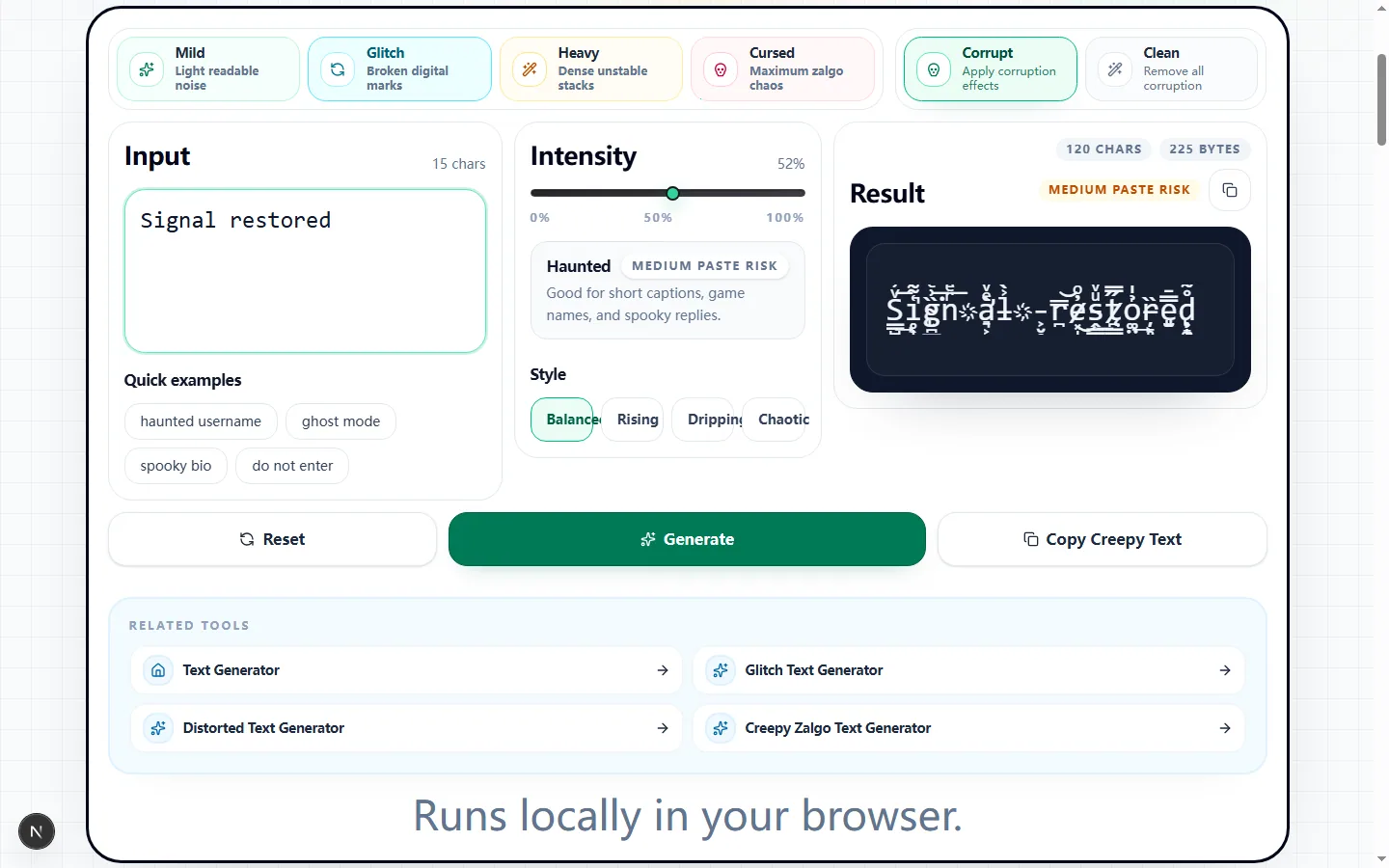
Start from a normal phrase, caption, username idea, or short horror line. The live output stays tied to your source text, so the corrupt text generator changes the look without changing the words.
Intensity
52%
Style
Result
103 chars
Try a nearby TextKits tool when you want a different copy-ready format, display style, or text effect.
Create animated glitch GIFs and copy-ready corrupted text.
Browse Unicode styles for bios, chats, and usernames.
Restyle sentences into mocking and alternating-case text.
Cross out text with Unicode line styles and copy-ready output.
Start from a normal phrase, caption, username idea, or short horror line. The live output stays tied to your source text, so the corrupt text generator changes the look without changing the words.
Preset chips change the mark family, while the style control changes how those marks spread above, through, and below the letters. Mild stays readable, while Cursed pushes into heavier zalgo text.
Use the live board to decide whether the result feels glitchy, cursed, or just unreadable. If the current pattern is close but not right, regenerate without rewriting the source words.
Once the text looks right, copy it for bios, usernames, captions, or meme text. Clean mode is there when you need to recover the readable base letters from corrupted Unicode.
A corrupt text generator takes your ordinary letters and layers them with crazy Unicode combining marks. The result looks broken, haunted, and unstable, but it still behaves like regular copyable text! Instead of creating an image, this tool generates real characters that you can paste directly into your username, caption, chat message, or bio.
We give you total control because corrupted text is super easy to overdo! A short word can become completely unreadable if every letter receives too many stacked marks. Our tool keeps your original message visible, letting you decide exactly how far to push the damage. Start with a readable glitch effect, move into heavier marks, or use the clean mode to strip the generated marks back out.
This kind of tool is perfect when you want to add an intense, eerie atmosphere to your words. People love using our corrupt text generator for horror captions, creepy profile names, gaming handles, Halloween posts, or anytime a message needs to feel uniquely damaged. It works beautifully on short text because the visual noise has more room to stand out!
For the best results, try to avoid super long paragraphs—they can become hard to read after corruption. Keep it punchy! If you want your text to look cool anywhere, use Mild or Glitch styles. If you're going for maximum cursed chaos, turn it up to Heavy!
You might hear these terms used interchangeably, but there's a difference! Glitch text usually implies a digital distortion—think broken screens and static. Zalgo text goes wild with stacked marks that climb way above and below your letters. 'Corrupt text' is the master term for all these damaged-looking Unicode styles.
Our corrupt text generator covers the entire spectrum. Mild adds a subtle texture, Glitch gives you broken digital marks, Heavy stacks things up, and Cursed delivers maximum zalgo chaos. Play around with the style buttons to find exactly the vibe you need!
Use this corrupt text generator when you need to damage regular text while keeping it copyable without opening a heavy editor or learning a special format first. It is made for people who want glitchy, cursed, or zalgo-style Unicode text, so the page keeps the input, preview, and output close together instead of hiding the useful controls behind a setup flow.
That makes the corrupt text generator best for quick text jobs like horror captions, game names, creepy bios, ARG clues, meme replies, Halloween posts, and cursed messages. In those moments, you usually already know the words you want to use. The value is seeing a clean result, adjusting it fast, and moving it into the app, post, sign, server, or document where it belongs.
The corrupt text generator workflow is built around one loop: write the source text, change the style, check the preview, then copy or export the result. The controls cover mild, glitch, heavy, cursed, clean mode, intensity, style choices, regenerate, and copy output, which gives you enough range without making the page feel like a full design program.
The live preview matters because small formatting choices can change the result quickly. If the text looks too crowded, too quiet, too strange, or too hard to read, you can fix it before copying. A useful corrupt text generator should make those problems visible early, while the text is still easy to change.
The strongest results usually start with short, clear text. A corrupt text generator can change the presentation, but it cannot rescue a message that is too long or confusing before the styling begins. Keep the source sentence simple, then use the tool to shape the final look.
This is especially important when the output is going into a public place such as a profile, chat, caption, booth, board, or server announcement. The corrupt text generator should add the effect you want while keeping the message easy to understand at the speed people will actually read it.
The fastest way to improve a result is to test a plain version first. Type the message, make one basic output, and ask whether it already solves the job. After that, add more style only where it helps. This keeps the corrupt text generator useful for real copy-paste work instead of turning every result into a noisy experiment.
For most users, the practical rule is: use lighter corruption for longer messages and heavier corruption for short titles or usernames. That habit makes the corrupt text generator more reliable, especially when another person needs to read the result quickly. The tool can generate options, but the final choice should still feel intentional.
Before you leave the corrupt text generator, look at the preview and ask one plain question: would someone understand this immediately? If the answer is no, shorten the source text, lower the intensity, or choose a simpler setting. The best output usually feels obvious, not overworked.
There is also one practical warning: very dense Unicode marks can be clipped or stripped by some apps. That does not make the corrupt text generator less useful. It just means the safest workflow is to copy or export the result, test it once in the target app, and make one final adjustment if the platform displays it differently.
A practical corrupt text generator should save time at the handoff point. You should be able to try a few versions, keep the one that works, and avoid rebuilding the same phrase by hand. That matters most for small text tasks where the goal is not a perfect design file, but a result you can use right away.
It also helps when you are comparing ideas. Keep one source line, change the settings, and let the corrupt text generator show the differences. Small shifts in size, style, color, intensity, or formatting can change the tone of short public text, and comparing those versions in one place makes the final choice easier.
The biggest mistake is treating the effect as the whole message. If every setting is pushed to the maximum, the output may look busy but stop communicating. Use the corrupt text generator to support the words, not bury them.
Another mistake is assuming every destination will display the result exactly like the preview. Keep a plain backup of the original text, paste the output into the target app once, and adjust if needed. That small check makes the corrupt text generator more dependable for real use and keeps the workflow focused on the actual next step.
Short answers to the compatibility and cleanup questions people usually ask before they paste corrupted text into another app.